
Home ➤ Dogs ➤ Dog Training Basicssafer, easier to live with
Dog Training is not about making a dog “obedient”, but about creating a system where your dog understands what is expected and feels confident responding to you in different situations. A well trained dog is safer, easier to live with and far less likely to develop behavioral problems that frustrate owners and strain the human animal bond over time.
Many first time dog owners assume dogs get trained naturally over time, through exposure and daily life. But most behavioral issues like pulling on the leash, jumping on guests, ignoring commands, destructive chewing or excessive barking result from a lack of structured training, not from stubbornness, dominance or a difficult personality. Dogs are are simply doing what has never been clearly redirected or corrected.
Basic dog training forms the foundation of everything else your dog will ever learn. Whether it is walking calmly in a busy public space, staying still at a vet clinic during an examination or coming back reliably when called in a risky situation near traffic or other animals, it all starts with a handful of core commands taught consistently and correctly from the very beginning.
Why Basic Dog Training Matters
Dog training directly impacts your dog’s safety, behavior, emotional well being and your own daily quality of life. A dog without clear guidance is constantly guessing, which leads to anxiety, unpredictability and frustration for everyone involved.
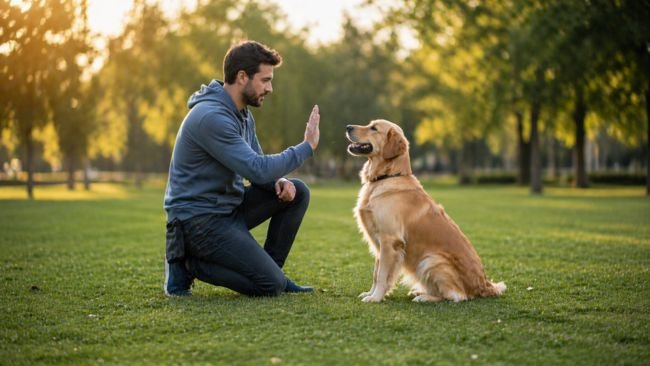
Improves Communication Between You And Your Dog
Dogs do not understand language the way humans do. They respond to tone, body language, patterns and learned associations.
Training creates a shared communication system where specific commands become clear, predictable signals rather than confusing sounds that blend into the noise of everyday human conversation.
Over time, a trained dog learns to read your cues accurately and respond with confidence, making every interaction smoother and more enjoyable.
Prevents Behavioral Problems Before They Start
Untrained dogs often jump on people, bark excessively, pull aggressively on the leash or completely ignore recall commands.
These are unmanaged behaviors that develop when no alternative is ever clearly taught. Early training intercepts these patterns before they become deeply ingrained habits that are far more difficult and time consuming to reverse.
Enhances Safety In Real Life Situations
Commands like “come” and “leave it” are genuinely life saving in the right circumstances. Imagine your dog darting toward a busy road, picking up a toxic substance from the ground or approaching an aggressive animal.
In these moments, a well practiced command can prevent serious injury or worse. Training gives you the ability to intervene effectively when it matters most.
Builds Trust And Mental Stimulation
Dogs are intelligent social animals that thrive on structure, purpose and clear expectations. Training provides meaningful mental engagement that goes far beyond physical exercise.
A dog that is mentally stimulated through regular training sessions is less likely to exhibit boredom driven destructive behaviors.
Trust built during training sessions deepens the bond between dog and owner in a way that casual interaction alone simply cannot replicate.
When To Start Training Your Dog
Dog training can and should begin as early as 8 weeks of age, which is typically when dogs are settling into their new environment. Young puppies are in a critical developmental window during which their brains are especially receptive to new information, routines and social learning.
They form habits quickly and adapt to structured patterns with remarkable ease. Starting early should avoid harsh discipline. It should be gentle, have positive exposure to basic expectations and commands that will serve them for life.
According to the American Kennel Club, early training significantly improves obedience and reduces long term behavioral issues in dogs.
Can Older Dogs Still Learn?
The idea that “you cannot teach an old dog new tricks” is a popular myth that has been thoroughly debunked by both behavioral science and practical experience. Adult dogs often actually learn faster than puppies in certain respects as they have longer attention spans, better impulse control and greater capacity for focused engagement during training sessions.
The main challenge with older dogs is not their inability to learn, but they first need to unlearn or override existing habits that have been reinforced over months or years. With patience and consistency, this is entirely achievable.
Why Early Habit Formation Matters
Dogs are fundamentally creatures of repetition and reward. They repeat behaviors that have worked for them in the past, which have produced food, attention, comfort or play. If undesirable behaviors go unchecked and unredirected in early life, they become deeply embedded default responses that feel natural and automatic to the dog.
This is why catching and correcting problematic patterns early before they become permanent behavioral defaults is always far easier than trying to reshape them later.
Core Principles Of Effective Dog Training
Understanding the principles behind effective training is just as important as knowing the specific commands. Without a sound approach, even the most dedicated training efforts can fall short.
Positive Reinforcement
Positive reinforcement is the most evidence backed and widely recommended training method available. The concept is straightforward – reward desired behavior using treats, enthusiastic praise, play with a favorite toy and the dog will repeat that behavior in order to receive the reward again.
This approach works because it aligns with how dogs naturally learn – through consequence and association. Positive reinforcement builds motivation, enthusiasm and a dog that actively wants to engage with training rather than one that complies out of fear.
Consistency
Consistency is the single most important factor in successful dog training. Every member of the household must use the same command words, the same tone of voice and the same reward system every time.
If one person uses “down” to mean lie down and another uses it to mean get off the furniture, the dog receives conflicting information that slows learning dramatically. Mixed signals do not just slow progress, they actively create confusion and anxiety, a pattern often seen in first time ownership.
The ASPCA highlights that consistent routines help reduce anxiety in pets, especially during early adjustment phases.
Short Training Sessions
Contrary to the instinct to train as long as possible to accelerate progress, shorter sessions produce significantly better results. Sessions of 5–10 minutes keep a dog’s attention sharp and prevent mental fatigue, which quickly leads to frustration and disengagement on both ends.
Multiple short sessions spread throughout the day are far more effective than one long marathon session that exhausts the dog’s capacity to process and retain new information.
Timing Of Rewards
The timing of a reward is critical to the accuracy of the association being formed. A treat or praise delivered within 1–2 seconds of the correct behavior clearly communicates to the dog exactly what action earned the reward.
A reward delivered even 5–10 seconds later may accidentally reinforce an entirely different behavior that occurred in the intervening moment. Precise and immediate rewarding is what builds reliable, accurate command responses rather than vague or inconsistent ones.
Avoid Punishment Based Training
Punishment based methods including yelling, physical corrections, shock collars or any technique designed to inflict discomfort are not only less effective than reward based training, but they actively damage the training relationship.
Punishment creates fear, stress and confusion rather than genuine learning. A frightened dog may suppress a behavior temporarily but does not truly understand what is expected and suppressed behavior frequently resurfaces or transforms into aggression or anxiety.
Modern behavioral science consistently supports positive reinforcement as the superior long term approach.
Essential Commands Every Dog Should Learn
Training builds a shared language between you and your dog. The right commands create structure, prevent chaos and keep your dog safe in unpredictable real world situations.
While there are dozens of commands you can teach, a small group forms the foundation of effective obedience. These commands help in differentiating between a well adjusted companion and a dog that reacts impulsively.
Sit Command
“Sit” is widely considered the single most foundational command in dog training. It establishes the basic principle of how training works – a specific action on the dog’s part produces a specific positive result. Sit creates a calm and controlled default behavior that can be applied in dozens of everyday situations where you need your dog to stop, pause and focus.

How To Teach Sit Command:
This beginner friendly method lures your dog by holding a small, high value treat close to your dog’s nose so they are clearly aware of it.
Slowly move the treat upward and slightly back over the dog’s head. As the treat moves backward, the dog’s natural response is to lower their hindquarters to the ground in order to keep tracking the treat – this is the sit.
The moment their bottom touches the ground, say “sit” clearly, deliver the treat immediately and follow with enthusiastic verbal praise. Practice this a few times in short sessions over several days until your dog starts to “sit” as soon as you say the command.
Avoid the common mistake of repeating the “sit” command multiple times before the dog responds (which teaches the dog to wait for the fifth repetition rather than the first), delaying the reward by even a few seconds (which reduces the clarity of the association) and physically pushing the dog into position (which creates discomfort and resistance rather than willing participation).
Use the command before placing a food bowl down to prevent frenzied jumping, ask for a sit when greeting guests at the door to prevent jumping up, use it at curbs before crossing streets or deploy it anytime you need to quickly calm an excited or overstimulated dog.
Stay Command
“Stay” builds two things simultaneously – patience and impulse control. A dog that can hold a stay is a dog that has learnt to resist the instinct to react immediately to every situation. This skill has enormous practical value in real world situations. Whether you need your dog to remain still while you open the front door, wait patiently while you prepare their meal or hold position while a stranger passes closely, the “stay” command delivers the control you need.
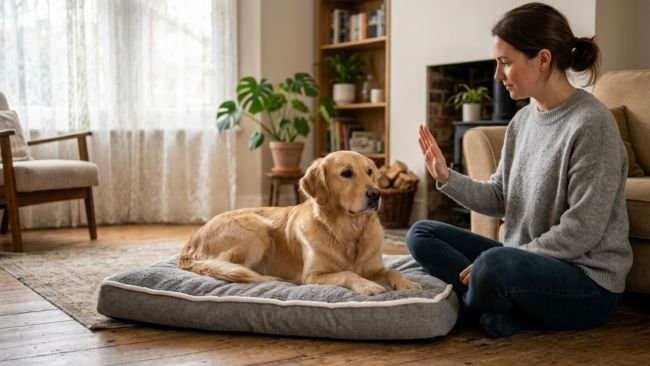
How To Teach Stay Command:
Begin from a solid and reliable sit. Once your dog is seated, give a clear, calm “stay” command and take one small step backward. If the dog holds position for even just two or three seconds, return calmly, reward generously and praise your dog.
It is critical that you return to the dog to reward rather than calling them to you as this would be practicing recall and not stay.
Gradually increase the three elements of difficulty one at a time – duration (how long they stay), distance (how far you move away) and distraction (what else is happening in the environment). Never increase all three simultaneously as this overloads the dog and causes the behavior to fall apart.
Come Command (Recall)
“Come” command is the most important from a pure safety standpoint. A dog that comes immediately and enthusiastically when called can be retrieved from dangerous situations before harm occurs. A dog with poor recall is at constant risk the moment they are off leash or slip out of a door or gate unexpectedly.
How To Teach Come Command:
The most important rule of teaching recall or “come” is to make coming to you the most rewarding experience possible.
Call your dog’s name followed by “come” in a genuinely happy, excited tone – the kind of voice that signals something wonderful is about to happen. When your dog reaches you, reward them lavishly with their highest value treats, enthusiastic praise, petting or play.
Never call your dog when you are about to do something they do not like (bath or nail trim), or they will stop coming when called. If you need your dog for something they dislike, go and get them physically rather than using the “come” command. Protect the positive association of that command.
Down Command
The down command – asking a dog to lie flat on the ground, encourages calm and settled behavior. It is one of the most effective tools for managing hyperactivity, over excitement or overarousal. A dog in a down position is in a naturally relaxed physical posture, which can help de-escalate the dog’s emotional state as well. It is also invaluable in social settings, at restaurants or cafes that allow dogs, during vet visits or anytime you need your dog to remain calm and still for an extended period.
How To Teach Down Command:
Starting from a sit position, hold a treat at the dog’s nose and slowly lower your hand straight down toward the ground between the dog’s front paws.
As your hand descends, the dog will naturally follow the treat downward and fold their front legs out in front of them into a down position.
The moment elbows touch the ground, say “down”, deliver the treat and praise warmly. Some dogs find this position more vulnerable than sitting and may need additional encouragement and patience before they feel comfortable and confident performing it reliably.
Leave It Command
Dogs explore the world primarily through their mouths, so they are constantly at risk of attempting to eat, chew or pick up things that range from mildly inconvenient to genuinely dangerous, from discarded food on sidewalks. to medications dropped on the floor or to toxic plants in the garden. The “leave it” command is your verbal intervention tool for these moments and a dog that responds reliably to it can be kept safe from a surprisingly wide range of hazards.
How To Teach Leave It Command:
Hold a treat at your hip or thigh level to encourage the dog to position themselves beside you. Take a few steps forward, rewarding the dog for staying in the correct position at your side.
Use the word “heel” as the dog is in the correct position so they associate the cue with that location relative to your body. When the dog pulls ahead, stop completely and wait or turn and walk in the opposite direction.
This moment pulling produces no forward progress and the behavior begins to lose its reinforcement. Gradually increase the complexity of environments as the dog’s heeling becomes reliable.
Heel Command
Leash pulling is one of the most commonly reported frustrations among dog owners and it can make walks stressful, exhausting and even physically dangerous, particularly with large and powerful breeds, where control becomes even more important. The heel command teaches a dog to walk calmly at your side without forging ahead or lagging behind, maintaining a comfortable position relative to your body regardless of distractions in the environment.
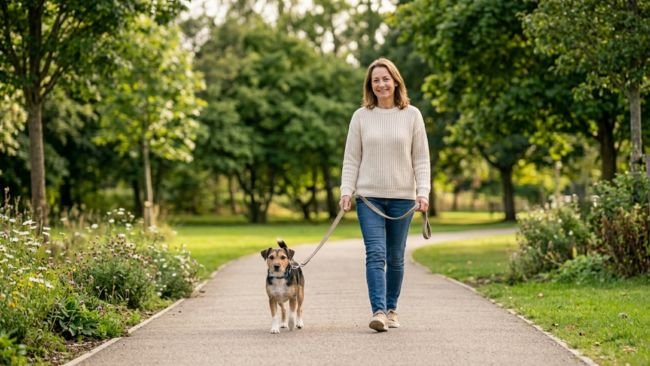
How To Teach Heel Command:
Hold a treat at your hip or thigh level to encourage the dog to position themselves beside you. Take a few steps forward, rewarding the dog for staying in the correct position at your side.
Use the word “heel” as the dog is in the correct position so they associate it with that location relative to your body. When the dog pulls ahead, stop completely and wait or turn and walk in the opposite direction.
The moment pulling produces no forward progress, the behavior begins to lose its reinforcement. Gradually increase the complexity of environments as the dog’s heeling becomes reliable.
No/Stop Command
Positive reinforcement forms the backbone of effective training, but having a clear “stop” command helps you quickly interrupt unwanted behavior. Whether a dog is chewing something valuable, approaching something dangerous, barking incessantly or beginning to display inappropriate behavior toward another animal or person, a strong “no” or “stop” command provides an immediate verbal interruption that buys you time to redirect them toward an appropriate alternative.
How To Teach No/Stop Command:
The key to a reliable “no” or “stop” command is consistent delivery – firm, calm and clear without shouting or escalating emotion. Shouting may stop the dog briefly or make them more excited, but does not teach real control.
When the dog stops the behavior, immediately redirect them to something appropriate and reward that alternative behavior. “No” should always be followed by a clear, positive alternative – not just punishment of the unwanted behavior in isolation.
Common Dog Training Mistakes To Avoid
Understanding what not to do is just as valuable as knowing best practices, as even well intentioned owners frequently fall into patterns that undermine their own training efforts without realizing it.
Inconsistent Commands
Inconsistent Commands are perhaps the most common and most damaging mistake. Using different words for the same behavior, allowing a behavior sometimes and correcting it other times or having different household members enforce different rules creates genuine confusion in the dog’s mind.
A confused dog cannot learn reliably, consistency is the non negotiable foundation of all progress.
Overtraining
Training for too long can overwhelm your dog, leading to distraction, loss of interest, or seeming stubbornness. When a dog starts making errors they previously had right, it is usually a sign of cognitive overload, not defiance.
Ending on a successful repetition and returning to training refreshed is always more productive than pushing through fatigue.
Lack Of Patience
Lack of Patience derails more training journeys than almost any other factor. Dogs learn at their own pace and progress is rarely perfectly linear.
There will be times when progress slows, your dog struggles with new distractions or forgets things they already learned. This is entirely normal.
Owners who interpret these natural fluctuations as failure and give up, change methods constantly or respond with frustration rarely achieve the results that patient and consistent trainers achieve.
Poor Reward Timing
Poor Reward Timing creates blurry associations that slow learning significantly. As noted above, the window for a reward to be clearly connected to the behavior it is meant to reinforce is extremely small – 1 to 2 seconds at most.
Fumbling for treats, offering praise too late or rewarding as the dog is transitioning into a different behavior all result in the dog learning something slightly different from what was intended.
How Long Does It Take To Train A Dog?
Time needed to train a dog depends on a few key factors. As a general guideline, most dogs can learn the basic mechanical understanding of core commands such as sit, stay, down and come within approximately 2 to 4 weeks of consistent daily training. However, mechanical understanding – the dog knowing what the command means in a calm, distraction free environment, is very different from reliable behavior.
Reliable behavior relates to the dog responding correctly to commands in real world conditions with varying levels of distraction, at different locations and with different people giving the commands, typically takes 2 to 3 months of consistent practice. Some behaviors, particularly recall and stay under high distraction, may take considerably longer to reach a truly dependable standard.
Breed plays a meaningful role, herding and working breeds bred specifically for trainability often progress faster, while scent hounds or more independent breeds may require additional patience and creativity. Age factor also comes into play, as discussed earlier. Ultimately, how fast your dog learns depends more on your consistency than your dog’s ability.
Dog Training Tools And Aids
The right tools can make training more efficient and more precise, eventhough no tool replaces the fundamentals of good training technique and relationship building.
Treats: Treats are the most universally effective motivator for food motivated dogs. High value treats like small pieces of cooked chicken, cheese or commercial training treats should be reserved specifically for training to maintain their motivational power. The size should be tiny, no larger than a pea, to prevent the dog from becoming full and losing motivation mid session while still maintaining a balanced diet.
Clickers: Clickers are small handheld devices that produce a distinct clicking sound used to mark the precise moment, a correct behavior occurs. The clicker’s value lies in its consistency and precision – it sounds identical every time, unlike the human voice and it can be delivered at the exact instant of the correct behavior before a treat is retrieved. Clicker training requires an initial “loading” phase where the dog learns that the click means a reward is coming, after which the click becomes a highly effective marker.
Leash and Harness: Leash and Harness combinations are essential for teaching heeling, managing a dog in public during training and maintaining safety. A well fitted front clip harness is particularly useful for reducing pulling during the learning phase, as it redirects the dog’s forward momentum to the side when they pull, making the pulling behavior physically less effective without causing discomfort or pain.
When to Consider Professional Dog Training
Most foundational training can be accomplished successfully at home with consistency, patience and a sound approach. However, there are specific circumstances where seeking guidance from a qualified professional trainer or veterinary behaviorist is strongly advisable.
Aggression Development: When your dog shows aggression toward people or other dogs, it goes beyond basic training and needs professional help. Aggression has specific triggers, thresholds and underlying causes that need expert assessment to be addressed safely and effectively. Attempting to manage or modify aggression without professional guidance can be dangerous and may make the problem worse.
Fear Based Behavior: Fear based behaviors like extreme shyness, phobias or anxiety often needs help from a professional trainer. These are not simple training problems, they often involve a combination of behavioral modification, environmental management and sometimes veterinary support including medication. A professional can design a systematic desensitization and counter conditioning program tailored to the specific dog.
If you have been training consistently for several months with no meaningful progress, a professional can assess your technique, identify what may be going wrong and make small changes to get progress moving again. Sometimes a single session with an experienced trainer is enough to spot a small but important mistake that is slowing progress down.
Building A Daily Dog Training Routine
The best training happens throughout the day, not just in sessions so your dog learns what is expected and gets rewarded regularly.
Sample Daily Routine:
A practical daily training structure might look something like this:
In the morning, before breakfast, ask your dog to sit and stay briefly, then use the meal as the reward.
During an afternoon walk, focus on recall practice in a safe, enclosed area, calling the dog back to you repeatedly and rewarding enthusiastically each time.
In the evening, work on leash manners and heel position during a short neighborhood walk. This distributes training across the day in manageable, naturally occurring moments rather than front loading all training into a single session.
Integration Tip:
The most powerful habit a dog owner can develop is using everyday activities as training opportunities.
- Every meal is a chance to practice sit and stay.
- Every door threshold is a chance to practice waiting for permission before passing through.
- Every greeting from a guest is a chance to practice not jumping.
- Every walk is an opportunity to reinforce heel position.
When training is integrated into daily life in this way, the dog receives far more repetitions than any dedicated session alone could provide, which dramatically accelerates the development of reliable and real world behavior.
Frequently Asked Questions
What is the first command to teach a dog?
Sit is the most recommended starting point because it is easy to teach using a lure, produces quick results that build the dog’s confidence and understanding of how training works and is immediately applicable in dozens of everyday situations.
How often should you train your dog?
Two to three short sessions of 5 to 10 minutes each per day is the ideal frequency for most dogs. This keeps engagement high and ensures learning is distributed across multiple repetitions without causing mental fatigue or diminishing the dog’s enthusiasm for training.
Can I train my dog at home?
Yes – the vast majority of foundational obedience training can be accomplished successfully at home without professional help, provided the owner commits to consistency, uses positive reinforcement correctly and maintains realistic patience with the pace of progress.
How long does training take?
Most dogs develop reliable behavior across core commands within 2 to 3 months of consistent daily training. Initial mechanical understanding of commands can emerge within 2 to 4 weeks, but real world reliability under distraction requires considerably more practice and proofing across varied environments.
How many commands should a dog know?
Every dog should have a reliable foundation of at least 5 to 7 essential commands – ideally sit, stay, come, down, leave it, heel and a clear interrupter command such as “no” or “stop.” Beyond this foundational set, additional commands can be added based on the dog’s lifestyle, environment and the owner’s specific needs.
Is it too late to train an older dog?
No – Older dogs are absolutely capable of learning new commands and behaviors. While you may need to invest additional time in overriding existing habits, adult dogs often bring better focus and a calmer disposition to training sessions that can actually make the process more efficient in certain respects.
What is the biggest training mistake?
Inconsistency is the single most damaging mistake in dog training. When commands, rules and reward systems vary from session to session or from person to person within the household, the dog cannot form clear and reliable associations. Inconsistency does not just slow progress, it actively works against it.
Should I use treats forever?
Not necessarily – treats are an essential tool in the early stages of teaching and reinforcing new behaviors, but the goal over time is to transition toward a variable reinforcement schedule, rewarding intermittently with treats while replacing consistent treat delivery with enthusiastic verbal praise, petting and play. Once a behavior is deeply established and reliable, most dogs will maintain it on praise and life rewards alone, though occasional treat reinforcement throughout the dog’s life helps keep the behavior strong.
Dog training is not a one time task with a defined endpoint. It is a continuous and evolving process that lasts the entire life of your dog. Commands need to be maintained, reinforced periodically in new environments and refreshed if they begin to drift. A dog that was reliably trained at six months and then received no further reinforcement will gradually lose the sharpness and reliability of those behaviors over time.
The rewards of consistent training, are enormous and lasting. A well trained dog is safer in the world, more confident in new situations, easier to manage in daily life and a genuine pleasure to live with. The investment of time and patience made during training pays dividends every single day for the rest of the dog’s life.
Consistency, patience and clarity are not just helpful qualities in a trainer but are essential ingredients that transform initial training into permanent and life long behavior. Every session you put in, no matter how short, is a deposit into a relationship and a skill set that will serve both you and your dog for years to come.
By Pettopedia Editorial Team
Pet Care Research & Content Team
Pettopedia Editorial Team is dedicated to helping pet parents make informed and confident decisions for their pet companions. Our articles are created through in depth research, practical insights with a strong understanding of animal behavior, nutrition and everyday pet health needs. Each piece is written to provide clear, reliable and actionable guidance that pet parents can trust.
Every Pettopedia article is carefully reviewed and updated to ensure accuracy, relevance and alignment with current pet care best practices. By combining a structured, long term content roadmap with a commitment to authenticity, Pettopedia aims to be the definitive digital encyclopedia for the modern pet parent. We aim to deliver content that is not only informative but also genuinely helpful in real life situations, which will help you and your pets thrive.