
Home ➤ Dogs ➤ Common Dog Behavior Problems And How To Fix Them
Dogs do not act without a reason. Every bark, every chewed cushion or every lunge at the end of the leash comes from something. Sometimes the reason is obvious or it is buried in a pattern you have not noticed yet.
You will see barking that refuses to stop no matter what you try. Shoes destroyed beyond recognition. A dog that pulls so hard on every walk it feels like your arm might give out. Furniture with bite marks you cannot explain. Guests who stop visiting because the jumping is too much to handle.
It gets frustrating fast. And if you do not step in early, small issues turn into habits that take months, sometimes years to undo.
Most of these problems are well understood, causes are predictable and fixes are repeatable. This article covers what is actually going on, why it happens and what you can start doing about it today.
What Are The Most Common Dog Behavior Problems?
Most owners are deal with excessive barking, destructive chewing, jumping on people, leash pulling, house soiling, separation anxiety and aggression. The specific dog, breed, house, neighborhood and the owner’s schedule all change, but the problems remain unchanged.
Many of these issues can be reduced early by taking the time to choose the right dog for your lifestyle, rather than adapting later under pressure.
These problems do not fix themselves. A dog that barks for attention and receives it will bark more because it has learned that barking works. A dog that chews furniture out of boredom will keep chewing until something in its environment changes. A dog that jumps on guests and gets touched, talked to or even pushed away – all of that is attention and attention is a reward.
Behavior that gets repeated gets reinforced. The longer a problem continues, the deeper it roots itself. Catching it early is far easier than trying to undo months or years of established habit.
Some breeds are naturally easier to manage, which is why understanding the best dog breeds for first-time owners can prevent many early behavior challenges.

What Actually Causes Behavior Problems In Dogs?
Most dog behavior problems trace back to five root causes – insufficient exercise, chronic boredom, inconsistent training, fear or anxiety and accidental reinforcement.
You did not plan to teach your dog to jump on guests. You did not sit down one day and decide to reward barking. But the first few times the behavior happened, someone in the house gave attention – a look, a word, a touch and the dog learned quickly. Dogs are efficient learners. They repeat whatever worked before.
Insufficient exercise is behind more behavior problems than most owners realize. A dog with too much energy and nowhere to direct it, will find its own outlets. Chewing, barking, pacing and destructive behavior are often simply the result of a body and mind that have not been adequately tired out.
Boredom operates similarly. Dogs need mental stimulation as much as physical activity. A dog left alone with nothing to do for long stretches will create its own entertainment and that entertainment rarely aligns with what you had in mind for your furniture.
Inconsistent training creates confusion. Dogs learn through patterns. When the rules shift depending on the day, the person or the mood in the room, the dog cannot form a clear picture of what is expected. That confusion often shows up as problem behavior.
Fear and anxiety are less obvious but equally important. A dog that barks aggressively at strangers may not be dominant or territorial. It may be frightened. A dog that destroys things near the door when left alone is not doing to get back at you, but is in distress.
If a behavior changed suddenly and without a clear cause, something in the dog’s world changed too. A new schedule, a new home, a reduction in activity, a change in household members or physical discomfort. Pain can shift behavior quickly and significantly. If the change is sudden and intense, check for a health issue before assuming it is just a behavior problem.
Energy requirements differ significantly and understanding how energy needs vary by dog size can help prevent under exercising your dog.
The 7 Most Common Dog Problems And How To Fix Them
Barking Too Much
Barking always has a trigger. It could be boredom, alerting, fear, territorial response or attention seeking. The approach that works depends entirely on which of these is driving it.
Start by watching patterns. When does the barking happen? Who is present? What changed in the environment immediately before it started? If it consistently happens when the dog is being ignored, it is attention driven. If it happens at every sound outside or every person who passes a window, it is alert behavior.
For attention driven barking, the fix is consistent non reinforcement. Ignore the behavior completely. No eye contact, no talking or no touching. The moment the dog goes quiet, even for a few seconds, reward that silence immediately. Start with very short windows of quiet and build from there. The dog learns that silence produces attention and not noise.
For alert barking, systematic desensitization works best. Expose the dog to the trigger at a low intensity – distance, volume or duration while pairing it with something positive like a treat. Gradually close the gap as the dog remains calm. This replaces the anxious or excited response with a neutral one.
Avoid shouting at a barking dog. It often reads as joining in and can make things worse.
Destructive Chewing
Chewing is a normal dog behavior. It is how puppies explore the world. It relieves stress, occupies time and feels satisfying. The problem is not the chewing itself – it is where it gets directed.
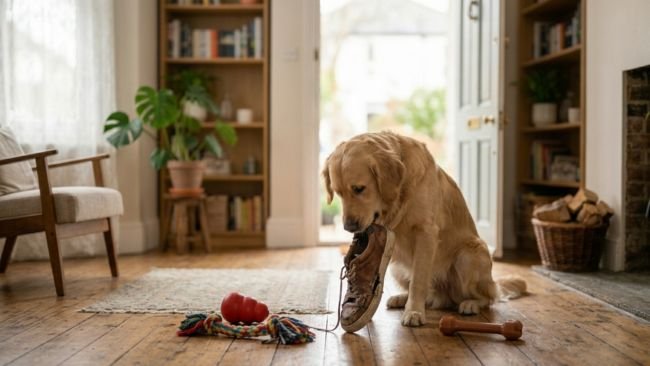
The immediate step is management. Remove access to things you do not want to get chewed. Use baby gates, closed doors or crates to limit unsupervised access to spaces where damage can occur. This is not a long term solution, but it prevents the behavior from continuing to practice and reinforce itself while you work on the underlying issue.
Provide better alternatives. Durable chew toys, bully sticks or frozen stuffed Kongs give the dog something appropriate and satisfying to chew. When the dog engages with the correct item, reinforce it.
If you catch the behavior happening, interrupt it calmly and redirect immediately to an appropriate chew object. Reward the correct choice. Do not make the interruption harsh or punishing. The goal is to redirect and not frighten.
Punishment after the damage is done accomplishes nothing useful. The dog will not connect the punishment to an event that happened earlier. You will create confusion and potentially fear without changing the chewing behavior at all.
Jumping On People
Jumping on people works because it reliably produces attention. The dog leaps up, the person reacts – whether with laughter, pushing away, or a verbal response and that reaction is the reward. Dogs repeat what gets a reaction.

The fix is to remove the reward entirely. When the dog jumps, turn away completely. Cross your arms. Make no eye contact and say nothing. When all four paws return to the floor, give calm and immediate attention.
Ask for an incompatible behavior before greeting. A sit is effective because the dog cannot sit and jump at the same time. When the dog sits, the greeting begins. When jumping starts, the greeting ends.
Consistency across every person the dog interacts with is essential here. One person who lets the dog jump, even occasionally, will slow the progress considerably. The rule needs to apply across the household and with guests.
Leash Pulling
Dogs pull because it moves them forward. They want to get somewhere – a smell, a person or another dog and pulling is what gets them there. It has been working, so they do it again.
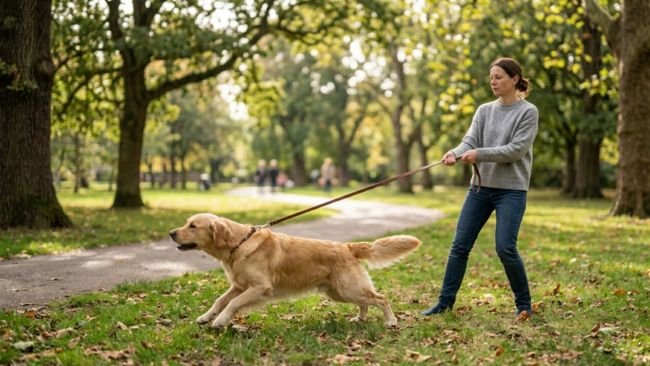
The fix requires making pulling stop working entirely. The moment the leash tightens, stop moving. Stand still and wait. The instant the leash loosens, move forward and reward. When the dog walks beside you without tension, mark and treat.
This feels slow at first because it is. Forward progress happens in short bursts with many stops. Over several consistent sessions, the dog figures out that the walk only continues when the leash is loose and behavior begins to shift.
A front clip harness can reduce the mechanical advantage the dog has when pulling and makes training easier. It does not replace the training, but it supports it.
House Soiling
Accidents in the house almost always come down to one of three things: incomplete training, a disruption to established routine or an underlying medical issue.
Before assuming it is behavioral problem, make sure it is not a health issue first – particularly in a dog that was previously reliable and has suddenly started having accidents. Urinary tract infections, kidney issues and other conditions can all affect housetraining behavior.
If health has been cleared, set a fixed potty schedule. Take the dog out at consistent times – after waking, after eating, after play or before bed. Stay outside until the dog eliminates, then reward immediately and enthusiastically. The reward needs to happen right after and not when you return inside.
Clean any indoor accidents thoroughly with an enzymatic cleaner. Standard cleaners do not break down the odor compounds that dogs can detect. If a faint trace of scent remains, the spot will continue to attract the dog as an acceptable toilet location.
Limit unsupervised access to the house until the dog is consistently reliable. Keeping your dog in a crate when you are not watching them, help prevent accidents from happening while training is ongoing.
Separation Anxiety
Separation anxiety is not misbehavior in the ordinary sense, but a stress response. The dog is not destroying things out of spite or boredom – it is in genuine distress when left alone.
Signs include barking, howling or whining shortly after you leave, pacing or drooling before departures, destruction concentrated near exits like doors and windows and accidents from a dog that is otherwise reliably housetrained.
The approach is gradual desensitization to your absence. Start with very short departures – seconds and not minutes. Return before the dog becomes distressed. Build duration slowly over multiple sessions and days. The goal is to keep the dog below the threshold of anxiety so that departures become routine and non threatening.
Keep departures and arrivals calm and low key. Drawn out goodbyes and enthusiastic greetings can actually amplify the emotional weight of your comings and goings.
Severe or long standing separation anxiety often requires more structured behavior modification and in some cases, veterinary input. Do not delay seeking help if the distress is intense.
Aggression
Aggression in dogs most commonly stems from fear, pain or insufficient socialization. It is rarely random and almost never unprovoked – the signal is often there. it is just being missed or misread.
Warning signs come before aggression – stiffening, hard staring, lip raising or growling. These are communication signals. Do not punish them. A dog that is corrected for growling learns to suppress the warning and may go directly to biting. The warning signal matters. It is telling you something.
Identify the specific triggers. Does it happen with strangers, with other dogs, near food or near certain spaces? Work with those triggers through controlled, low intensity exposure and reward calm behavior. The goal is to change the emotional association with the trigger – from threat to neutral or positive.
If there is any history of biting or if aggression is unpredictable, do not attempt to manage it alone. Work with a certified professional. This is one area where DIY approaches carry real risk.
How To Actually Correct Dog Bad Behavior
The underlying structure of correction is simple regardless of the specific behavior:
- Identify the trigger – what is consistently present when the behavior occurs
- Interrupt calmly – not with punishment, but with a neutral signal that breaks the behavior chain
- Redirect to the desired behavior – show the dog what you want instead
- Reward immediately – within seconds of the correct response

Timing is everything. A reward or consequence that arrives more than a few seconds after the behavior loses its connection to the behavior entirely. The dog learns from what is happening right now and not from what happened a few moments ago.
A strong foundation in basic dog training commands makes redirection far more effective, especially when the dog already understands what is expected.
Consistency matters more than intensity. A clear, predictable pattern applied every time produces far better results than occasional strong corrections. Dogs learn through repetition. Give them something reliable to learn from.
Mistakes That Make Dog Behavior Problems Worse
Even well meaning owners can unintentionally reinforce the very behaviors they are trying to fix. Dogs do not act out of spite or stubbornness – they respond to patterns, clarity and consequences.
When those elements are inconsistent or incomplete, confusion builds and unwanted behaviors tend to intensify rather than improve. Understanding these common mistakes helps you avoid setbacks and keeps training progress steady and predictable.
Inconsistent Rules
Changing expectations from day to day, person to person or mood to mood creates confusion. A dog that is sometimes allowed on the furniture and sometimes corrected for it has no clear picture of the rule.
Keeping expectations consistent – even when it is inconvenient, is foundation to good behavior.
Punishment Without Guidance
Stopping a behavior without showing an alternative, leaves the dog without direction. The energy that drove the unwanted behavior has to go somewhere.
Without a clear replacement, the dog will find its own outlet, which is usually not what you had in mind. Correction works best when paired immediately with redirection to something appropriate.
Insufficient Exercise And Mental Stimulation
A dog that is physically and mentally tired is a calmer dog. Unspent energy has to go somewhere and it usually surfaces as barking, chewing, pacing or other unwanted behaviors.
Regular walks, fetch, training sessions and puzzle toys reduce the energy surplus that fuels many common problems. Address the energy level first and some behavior issues will reduce significantly on their own.
Waiting Too Long To Address Problems
Many owners wait to see if a behavior resolves on its own. It rarely does. Behavior that repeats gets more established over time.
Addressing a problem at two months old is dramatically easier than addressing the same problem at two years. The earlier the intervention, the faster and more complete the outcome.
How Long Does It Take To Fix Dog Behavior Problems?
There is no single answer because the timeline depends on several variables working together:
- The dog’s age – puppies tend to acquire new behaviors faster, though they also have shorter attention spans
- How long the behavior has existed – a habit that has been practicing for two years is more established than one that started last month
- How consistently training is applied – daily consistency produces faster results than sporadic effort
- The dog’s individual temperament and history
- Whether the environment supports the change or undermines it
Progress does not always look linear. There will be sessions that feel like nothing is sticking and weeks where improvement is obvious. The more useful measure than perfection is trend – Is the behavior happening less often? Is it stopping sooner when it does happen? Is the dog responding faster when redirected?
Puppies often show meaningful improvement within days to a few weeks on straightforward issues. Deeply established habits in adult dogs may take several months of consistent work. Severe anxiety or aggression may take longer still and benefit from professional support.
When To Get Professional Help For Dog Behavior Problems?
Some dog behavior situations call for professional intervention rather than a home based approach.
Seek help immediately if your dog has bitten someone, if aggression is escalating or unpredictable or if the situation poses a safety concern for people or other animals.
Consider professional support if you have been working consistently on a behavior for several weeks without meaningful progress, if separation anxiety is severe and not responding to gradual desensitization or if the behavior is causing significant disruption to daily life.
Look for certified applied animal behaviorists, veterinary behaviorists or trainers with recognized credentials – such as those certified through the Certification Council for Professional Dog Trainers. Be cautious with trainers whose approach relies primarily on punishment or aversive tools, as these methods can worsen fear based and anxiety driven behavior.
A sudden and significant behavior change in a previously well behaved dog warrants a veterinary check before a behavior consultation. Pain, illness and neurological issues can all present as behavioral problems.
How to Prevent Dog Behavior Problems In the First Place?
Prevention is considerably easier than correction. The groundwork laid in the first weeks and months of a dog’s life or the first weeks in a new home shapes behavior significantly.
Start training as early as possible. Basic coomands like sit, stay, come and leave it, give the dog a language to communicate with you and give you tools to redirect behavior before it becomes a problem.
Reward good behavior when you see it. Dogs repeat what gets reinforced. If you notice your dog lying calmly, settling without being asked, or choosing a toy over a shoe – mark it and reward it. Catching the right behavior is as important as correcting the wrong one.
Socialization during the early weeks and months matters enormously. Gradual, positive exposure to different people, animals, sounds, environments and surfaces helps dogs develop into adaptable, confident adults rather than fearful or reactive ones.
Build daily structure into the dog’s routine. Fixed feeding times, consistent walk schedules and regular training sessions, even five to ten minutes a day provide predictability that reduces anxiety and supports good behavior.
Dog Training Tools That Actually Help
Certain tools can support training and make progress much easier, though none of them replace the underlying work. A front clip harness reduces pulling by steering the dog back toward you when tension is applied. It gives you more mechanical control without discomfort to the dog.
A crate provides a safe, contained space when supervision is not possible. Properly introduced, it becomes a place the dog chooses voluntarily, not a punishment. It prevents unsupervised practice of unwanted behaviors during training.
Chew toys and long lasting chews like stuffed Kongs or durable rubber toys give the dog an appropriate outlet for chewing and an activity for quiet time.
Enzymatic cleaners are essential for housetraining. They break down the biological compounds in urine and feces that standard cleaners leave behind and that attract dogs to repeat in the same spot.
A long training leash – typically ten to thirty feet, gives the dog freedom to move and explore while you maintain a connection for recall practice and control in open spaces.
Use tools to support good training. Do not rely on them as a substitute for it.
Frequently Asked Questions
How do I fix my dog’s bad behavior?
Find the specific trigger, apply a consistent response every time the behavior occurs, redirect to an appropriate alternative and reward the correct choice immediately. Consistency and timing matter more than the intensity of the correction.
Why did my dog suddenly start acting out?
Sudden changes in behavior are almost always linked to a change in the dog’s world – a new routine, a move, a change in household members, reduced exercise, increased stress or a health issue. If the change is abrupt and significant, rule out pain or illness first.
Can I fix this at home?
The majority of common behavior problems can be addressed at home with consistent training. Severe aggression, significant separation anxiety and situations involving safety concerns benefit from professional guidance.
Is it too late for an older dog?
No. Older dogs are fully capable of learning new behaviors. It may take more time and more repetition than it would with a younger dog, but the capacity to change is there. Age is not a barrier, established habit is and habit can be changed with consistent effort.
How do I know if the training is actually working?
Look for trend rather than perfection. The behavior is working if it happens less often, stops sooner when it does happen and the dog responds faster when redirected. Progress is rarely linear. Improvement over weeks matters more than any single session.
Most dog behavior problems come down to two things – unmet needs and inconsistent responses from the people around them. It is trying to get its needs met using the tools it has and the tools it has been accidentally taught work. Fix those two things – meet the needs and respond consistently and most issues begin to improve on their own.
You do not need complex methods or elaborate training systems. You need clarity about what you expect, consistency in how you respond and patience with the pace at which learning happens. Dogs learn through repetition and pattern. Give them clear, predictable ones and they will follow.
Some problems improve within days once the right approach is applied. Others take weeks or months of steady work. What matters most is not speed, but staying consistent through the slow stretches and not abandoning a method before it has had time to produce results. Despite the challenges, understanding why dogs make great pets puts these efforts into perspective and reinforces the long-term reward of responsible ownership.
If something feels genuinely beyond your ability to manage, getting professional help early prevents the problem from becoming more entrenched. There is no value in waiting and hoping. The earlier you address it, the easier it is to change.
Keeping the approach simple and staying consistent, always works.
By Pettopedia Editorial Team
Pet Care Research & Content Team
Pettopedia Editorial Team is dedicated to helping pet parents make informed and confident decisions for their pet companions. Our articles are created through in depth research, practical insights with a strong understanding of animal behavior, nutrition and everyday pet health needs. Each piece is written to provide clear, reliable and actionable guidance that pet parents can trust.
Every Pettopedia article is carefully reviewed and updated to ensure accuracy, relevance and alignment with current pet care best practices. By combining a structured, long term content roadmap with a commitment to authenticity, Pettopedia aims to be the definitive digital encyclopedia for the modern pet parent. We aim to deliver content that is not only informative but also genuinely helpful in real life situations, which will help you and your pets thrive.